To view my galleries, find out more information about me, and to contact me, please visit my website.

Showing posts with label Exposing The Wild. Show all posts

Thursday, 11 November 2010

A Little Transparency

My blog posts are like buses.

Generally annoying and widely disregarded by the general public?

Probably, but you also wait for ages before two come along at once. The metaphor almost works but, in reality, no-one is waiting. Still, just as bus drivers amuse themselves by squashing cats and parking on pedestrian crossings with their empty buses, I shall amuse myself by spouting drivel and wearing out my keyboard with my unheeded words.

In the spirit of yesterday's blog post, I have decided to do a little exposé of one of my images:


This image is part of Exposing The Wild's Scottish Project and features in Drama in the Garden, which I produced as part of the project. At the project's climax, Samuel Waldron and I exhibited the image as part of two exhibitions in the Scottish Borders.

Throughout the exhibition, I tried to explain to as many people as possible how the image was produced as I wanted no-one to leave with a false sense of the image. As far as I am aware, everyone was genuinely interested and appreciated me sharing what many thought I might consider a trade secret.


How then did I produce the image? The image shows the same Blue Tit in six different poses. The bird was nesting nearby and, when I noticed it visiting a suet-filled hole designed to attract woodpeckers, I decided to try to photograph the Blue Tit as well.

Initially, the bird flew to the suet from varying vantage points making it almost impossible to anticipate its flightpath. I placed a stick just out of frame, which the bird started using instead. Once the bird was using this new and more direct route, I placed the camera at 90 degrees to the flightpath and manually focused upon it so the bird would always be in focus when flying between the stick and suet.
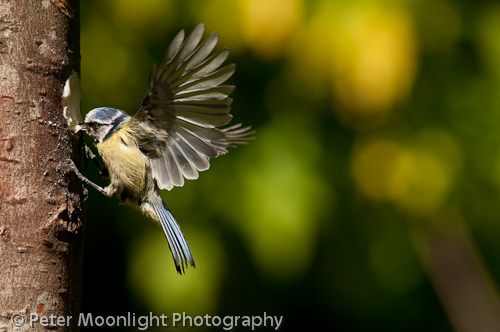

I decided to used a 60mm macro lens as it produced a brilliantly sharp image whilst blurring the background but keeping enough definition to give the image context. This meant I had to use an remote trigger and sit a few meters from the camera so as not to spook the bird. I simply fired the camera (and attached off camera flash) every time the bird used the flightpath.

After two days I had taken over a thousand shots. The vast majority did not contain the bird at all and many of those that did only showed the tail; but, within the 100 or so shots that survived the cull, I found five which together produced a realistic looking image of a Blue Tit flight path. I edited these together in photoshop. The final image is actually a composite of six images: five of the bird and one of the background.


The image is not a true flight path, it is the illusion of a true flight path. No photograph can presents an truly accurate view of reality. All we can do as photographers is strive to replicate reality as accurately as possible. We are, as I recently heard BBC Producer Barry Paine say, are in the business of creating the illusion of truth.

I do not think any visitors to the exhibition minded having their illusions shattered. Most were simply fascinated by the effort behind this single image, regardless of whether I used the ethically questionable practices of baiting and severe editing. I would much rather fascinate and inspire by explaining an illusion than by presenting an illusion as truth.

Wednesday, 10 November 2010

WildPhotos Ethics Declaration

"Excuse me, can you tell me how to find the Royal Geographic Society?"

"Shouldn't you be asking them that?"

I would probably have found this a little funnier had I not spent the previous night poised over a relative's toilet bowl following an unfortunate reaction to a Chinese takeaway. My comedic advisor, however, probably assumed my dehydrated and tired appearance was the result of a late-night schmoozing session with a high-flying executive. I was, after all, in London.

I had ventured to the capitol to visit WildPhotos, an annual program of talks and debates where the Bence Mates of this world explain spending the last year blow-drying leaf cutter ants while Klaus Nigges justify dressing as a pelican and photographing urinating jet-skiers. If you are in any doubt that wildlife photographers are an odd bunch, this is the event for you.

Somewhere though between Chris Packham assaulting an Andy Rouse effigy with a super soaker and Stefano Untertheiner recalling his love for an albatross, the organisers somehow managed to find time to fit in a relatively sane debate on photographic ethics.

"Photographic Deceit: How far is too Far" was chaired by Mark Carwardine and began with a survey. The audience of professional and amateur photographers were asked to show their hands in response to a series of questions on baiting, captive subjects, editing, and captioning. The answers regarding baiting follow:

  • 95% would leave food to attract birds.
  • 70% would feed roadkill to a predator.
  • 20% would feed a live mice to a wild owl.

The full results, which are available here, show starkly that everyone has an opinion on how far is too far but that everyone's opinion varies. Over the next hour, many valid points were raised and discussed but I think that wildlife cameraman Doug Allan summarised the mood best. He stated that photographers and cameramen should do only what they feel comfortable with and would be ready to defend, whilst being completely transparent.

Most delegates agreed that photographers are not necessarily the best people to judge their own actions but that they should make it possible for others to do so. This was included in a Ethics Declaration, available here,  which many delegates (including me) agreed to sign and have since done so.

I, as a developer and user of the Exposing The Wild Captioning System, believe that the system is the simplest and most complete way of doing this available. However, if it is not for me to judge my own photographic actions, perhaps it is not best for me to judge my own captioning system. I will simply be fully transparent about my reasons for creating and using it and let others judge whether it is for them.

Wednesday, 23 June 2010

New Captioning Website!

Stop! Newsflash! The Exposing The Wild Captioning System website is up and running, complete with fancy slideshows like the one below!


Content on this page requires a newer version of Adobe Flash Player.

Get Adobe Flash player


The Captioning System has also had a revamp, and the new final draft is more comprehensive and unambiguous than ever. If anyone has any comments on the system, it would be great to hear them.

If any photographers out there would like to use the system, please do. The more the merrier! If you could just link to the website, that would be great.

My website (www.moonlightimaging.com) has also been updated and takes into account the new changes.

Unfortunately, I will be unable to update my older blog posts, I am simply too busy and have spent too many hours in front of the computer in the last few days finalising the website, as my bloodshot eyes can testify.

Anyway, that is it! The system is out there! Lets see how far we can take it.

Saturday, 22 May 2010

Recipe for a frustrated photographer


1) Take one photographer, one camera, and one tripod.

2) Place in a nettle-lined canvas oven.

3) Cut a slit in the oven overlooking a perch positioned over a stretch of the idyllic Scottish river Whiteadder.

4) Garnish with a covering of midges.

5) Sun-bake for four and a half hours on the hottest day of the year so far.

6) Do not, on any account, let a kingfisher alight on the perch.

Well that was an unproductive morning. Off to another hide this afternoon? I think so!

Sunday, 28 March 2010

When location is not enough

Wherever possible I have been discussing the Exposing The Wild captioning system with fellow photographers. Some have been skeptical and others enthusiastic.


One peer commented that she sees no benefit in the classification of wild and captive animals, stating that she would rather include the location the photograph was taken in the caption. This, she believes, gives people enough of an idea about the situation a photograph was taken in to make the Exposing The Wild captioning system irrelevant.

However, is this not assuming a huge knowledge base? There are a huge number of deer parks and animal parks in the UK. Is a viewer expected to have heard of all of these? Even mainstays of the wildlife photography community such as the British Wildlife Center are not well known throughout the general public.

Perhaps my colleague assumes viewers will be able to guess the nature of a location by its name. However, this also has its problems. Is it immediately obvious that the Cotswold Wildlife Center, for example, is effectively a zoo?


There are also situations where even knowing the nature of a location will not be enough to get a flavour of the of the animal's situation. A perfect example of this is WWT Slimbridge. Slimbridge is famous for having the largest collection of wildfowl in the UK. However, spread throughout these captive birds and visible from Slimbridge's hides are an equally large number of wild birds. Some of these are even the same species as the captive birds!

How is a viewer supposed to judge whether an image shows a wild Tufted Duck on the estuary or a collection bird with clipped wings? It is usually immediately obvious to the photographer, so is adding six little characters really too much to ask?

Wednesday, 17 March 2010

The Exposing The Wild Captioning System

If I have said it once, I have said it a thousand times; images are powerful. However, there is one sure-fire way of sucking the power out of an image leaving little more than shapes and colours. That is to question its integrity.

Integrity is the wildlife photography buzzword of the day. It is questioned as much as claimed, but there is no real way of measuring it. A photographer's reputation is the sum of their honesty, their ethical practice, their photograph's integrity, and any perceived breaches of these. A photograph's integrity is based upon the not only on the photographer's reputation, but also the circumstances in which it was taken, how much it has been processed, and whether this is declared.

Currently, there is no standard way for photographers to declare how photographs were taken. Many photographers commendably state that image were "taken under controlled conditions", but what exactly are controlled conditions? I am sure everyone agrees that a falconry bird flown over a photographer's head certainly constitutes controlled conditions, but how about Stags in deer parks, or baited animals? Both are certainly controlled to some extent but it is debatable whether this is enough to constitute controlled conditions.

Other photographers add the world "captive" or a capitol C to their images as they think appropriate. This is just as commendable but just as ambiguous as adding "taken under controlled conditions". Is an Elephant left to behave as wild in an enclosure the size of an English county captive or wild? I can see both sides of the coin. Unlike the mice it undoubtedly lives with, the Elephant's huge natural territory means its movements are still constrained by humans, but this makes it no easier to photograph.

Similar ambiguities exist in the world of Digital Manipulation. Some maintain digital manipulation includes all "photoshopping", others state that global exposure and colour edits do not count whereas local edits do, while others believe that a subject or background has to be moved, removed, or added to count.

Ambiguities such as these can lead to the integrity of photographers and their photographs being unfairly questioned over simple misunderstandings. It is impossible for photographers to write detailed captions for all of their photographs containing all relevant information, yet they can easily be caught out when they do not.

Because of these worries, I have devised a quick and easy coding system for Exposing The Wild with the aid of Samuel Waldron that uses a code to summarise all relevant information. The system does not aim to judge, it simply categorises images to minimize their potential to mislead viewers unintentionally.

Post Processing

Images are split into one of four categories depending upon how much they have been edited:

PP0 - photographs that have undergone no post processing.
PP1 - photographs that have been subjected to global edits*.
PP2 - photographs that have been subjected to local edits**.
PP3 - photographs where subjects or backgrounds have been added moved or removed.

*Any edits that affect the entirety of the image, e.g. colour balance, curves, or contrast.
**Any edits affecting only part of an image, e.g. graduated filters, dodging and burning.

Captive Animals

Captive animals (including captured wild animals) are split into three categories:

CA1 - Captive animals that behave as wild in large enclosures.
CA2 - Captive animals whose behaviour is partially controlled.
CA3 - Captive animals whose behaviour is completely controlled*.

*e.g. trained animal models, falconry birds, and studio animals.

Wild Animals

Wild animals are also split into three categories:

WA1 - Wild animals whose behaviour is not affected by humans.
WA2 - Wild animals baited or attracted by humans.
WA3 - Wild animals habituated to the presence of humans.

The relevant codes are simply added to the end of captions to furnish the viewer with as much information as possible. For example, an image of a wild Blue Tit attracted to a Oxfordshire bird feeder where the exposure, colour balance, and contrast had been globally edited would be captioned as:

"Blue Tit, Oxfordshire, WA2, PP1."

Even if all photographers immediately adopted the Exposing The Wild captioning system and all images were correctly labelled, I am sure there would still be just enough ambiguity left to spark the occasional controversy. However, this will not put me off from promoting the system and adopting it on all of my own images. I am simply not prepared to do nothing.

---

Edit: My Exposing The Wild colleague Samuel Waldron has also discussed this topic but has looked at it in a slightly different way. His enlightening discussion can be found here.

Tuesday, 9 March 2010

Scotland. Just.


For a while now I have been longing to get a proper photographic project under my belt. It is all very well and good jaunting down to Donna Nook or even poking a lens into a garden you know intimately whenever you can, but documenting an area intimately is another thing entirely.

This is what my collegue Samuel Waldron and I will be doing with a small area of the Scottish Borders on the River Whiteadder (pronounced whit-adder) from May to Mid July. We will be doing so under the banner of "Exposing The Wild", a new cooperative venture which will soon be firing on all cylinders. You shall, of course, be the first to know when it is!

From Thursday to Sunday Sam and I were at the site assessing its potential and preparing for the summer shoot. We busied ourselves so much with that that we did not get much photography done, the exception being moonless and cloudless Thursday night when we had a play with star-trails.

The top image is a 20 minute exposure showing the movement of the stars around the pole star. This shot was taken with the lights of Preston in the foreground. With these in the image I was unable to get an exposure longer than 20 minutes without the sky lighting up enough to render the majority of the stars invisible.


This second shot was taken in the opposite direction so light pollution had a much lesser effect. The star trails in this photograph are much longer because the image was taken at right angles to the north star and also because the exposure was 30 minutes long.


Preparation for the summer included searching the woodland for animal signs (such as the badger tracks above - thank you to the members of Wild About Britain for confirmation of this identification) and hide building. We first coppiced an area of willow to provide building materials and an open area for bird hides, before building a simple live woven willow structure with a pine roof. We will add the bird feeders to the area in the spring.

My final shot shows us enjoying "disposing of" the excess willow.